

Workplace First Aid Kit Requirements, Prices and Expiry Checks
UK workplaces must provide appropriate first aid equipment, including a first aid kit suited to workplace risks. The law does not prescribe a single list of contents. Kits may last three to five years, but individual items can expire sooner, so regular checks are essential. This guide explains how to assess your workplace’s needs, keep supplies ready and respond to severe bleeding.
Key Takeaways
- Base workplace supplies on a first aid needs assessment, and keep them in a clearly marked place employees can reach.
- Choose contents to match workplace hazards; consider sterile water or saline for eye irrigation where tap water is not readily available.
- Inspect supplies regularly, replacing used, expired or damaged items and checking sterile products carefully.
- For severe bleeding, understand how dressings and roller bandages can help while ensuring the response suits the workplace’s assessed needs.
Workplace first aid kit requirements
UK workplaces must provide appropriate first aid equipment, facilities and supplies. A needs assessment determines what is suitable; BS 8599 is a suggested standard, not a legal requirement.
Assessing workplace first aid needs
Record workplace hazards, staffing patterns, lone working and locations in the first aid needs assessment. Use its findings to decide equipment, kit numbers and any additional facilities. BS 8599 outlines recommended workplace contents, but compliance is not legally required. Workplace rules do not set a household count; keep home supplies where residents can reach them. This workplace guidance does not set a private-car carrying rule; include work vehicles in the assessment.
Kit location and access
Keep the kit in a clearly marked, accessible place that employees know. A green box with a white cross is commonly used, and staff should be able to reach it promptly. Use signs and induction instructions to show its location, including on separate floors or in distinct work areas. If the workplace has several locations, assess whether one central kit is practical or whether supplies are needed closer to where incidents could occur.
Workplace first aid supplies
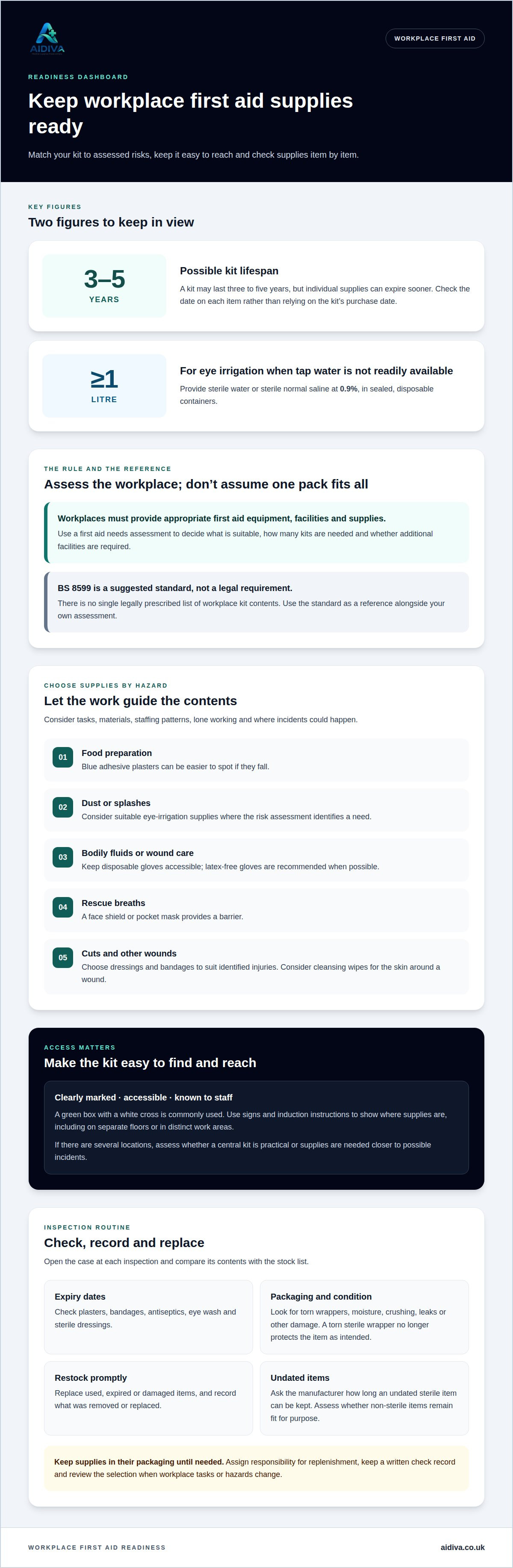
Common contents include a first-aid leaflet, sterile plasters, disposable gloves, wound dressings, bandages, safety pins and sterile eye pads. Wear gloves when cleaning wounds, handling bodily fluids or disposing of waste; latex-free gloves are recommended when possible. A face shield or pocket mask provides a barrier during rescue breaths. For eye irrigation, UK Government says that if mains tap water is not readily available, provide at least one litre of sterile water or sterile normal saline (0.9 %) in sealed, disposable containers. Use plasters to cover minor cuts.
Keep equipment aligned with the workplace risk assessment: UK workplaces must provide appropriate first aid equipment based on a risk assessment and ensure it is accessible and maintained. The kit’s contents should be based on the workplace’s first aid needs assessment. Workplace and public-area kits should be stocked according to the risks people could encounter at that location.
Make sure employees know where the kit is kept. It should be clearly marked, accessible and easy to find, often in a green box with a white cross. Because there is no legally prescribed list of first aid supplies for UK workplaces, use your assessment to decide what the kit should contain.
Choosing and stocking a workplace first aid kit
Choose supplies to match the hazards recorded in your workplace first aid needs assessment. Consider the tasks people do, the materials they handle and where incidents could happen. A low-risk office and a workshop with machinery may need different contents. Aim to keep relevant supplies available, rather than adding items without a clear purpose.
Use specific tasks to guide your choices. A food preparation area may need blue adhesive plasters, which are easier to spot if they fall. Work involving dust or splashes may call for suitable eye-irrigation supplies. Where staff handle bodily fluids, include accessible disposable gloves. The assessment should account for these hazards and any separate work areas.
BS 8599 gives recommended workplace contents based on risk and the number of people. It is a suggested standard, not a legal requirement. Use it as a reference alongside your own assessment, rather than assuming one standard pack suits every workplace.
- Match wound dressings and bandages to the injuries the assessment identifies.
- Include sterile eye pads where eye injuries are a relevant risk.
- Keep disposable gloves available for wound care and cleaning bodily fluids.
- Add a face shield or pocket mask for a barrier during rescue breaths.
- Consider cleansing wipes for cleaning skin around a wound.
Keep supplies in their packaging until needed to protect sterile items. Replace used items promptly and record each restock. This prevents a box that appears stocked from being short of an important dressing or glove size during an incident. Assign responsibility for replenishment and arrange the contents so staff can find items quickly. Review the selection whenever workplace tasks or hazards change, and update it to reflect the new assessment.
Kit lifespan and checking expiry dates
A kit may last three to five years, but individual supplies can expire sooner. Check the date on each item instead of relying on the kit’s purchase date. Bandages, antiseptics, eye wash and sterile dressings may have separate expiry dates. Replace items that are expired, used or damaged so the supplies remain suitable for emergency use.
At each inspection, open the case and compare its contents with the stock list. Check plasters for expiry dates, intact wrappers and signs of moisture or damage. A torn sterile wrapper no longer protects the item as intended. Look for crushed packaging, leaks or changes in condition, and remove anything that is not suitable for use.
- Record the inspection date and any supplies removed or replaced.
- Check sterile dressings and eye pads for intact seals and expiry dates.
- Review antiseptics and eye wash for dates, leaks and damaged containers.
- Replace plasters and bandages after use, or if packaging is compromised.
Some supplies may not have a printed expiry date. For an undated sterile item, ask the manufacturer how long it can be kept. For a non-sterile item, assess whether it remains fit for purpose. Do not assume an undated sterile dressing is suitable just because its wrapper looks intact.
Keep a written record of checks and restocking beside the kit or in a workplace log. Records can reveal recurring gaps, such as frequently used plasters or eye wash nearing expiry. Store replacements according to their packaging instructions, then update the stock list. A clear routine helps staff distinguish usable supplies from items awaiting replacement.
Bleed control and haemorrhage management
Severe external bleeding calls for a prompt, organised response. In a workplace, summon emergency help while a responder uses suitable supplies. Dressing pads and roller bandages are practical options for emergency care: a pad covers the wound, and a roller bandage can secure it and maintain pressure.
Include suitable supplies when your workplace assessment identifies bleeding as a relevant hazard. Match the stock to tasks and risks, such as work with tools or machinery, rather than assuming every site needs identical equipment. Keep supplies together, clearly labelled and accessible. Make sure staff know where they are, and replace used or expired items during routine checks.
- Dressing pads cover the wound area.
- Roller bandages secure dressings and maintain pressure on wounds.
- Trauma dressings may be included in a public access trauma kit.
- Tourniquets and chest seals may also be included in that kit.
A public access trauma kit is intended for bystanders responding to serious bleeding or mass casualty emergencies. It may contain tourniquets, chest seals and trauma dressings. These specialist items differ from routine dressings and bandages. Use the workplace assessment to determine whether site risks call for additional bleed-control equipment and where to keep it.
Emergency services use bleed control kits to manage external bleeding before hospital care. In workplace settings, keep equipment aligned with identified risks, record checks and replace items after use. A planned response helps staff locate suitable supplies without searching through unrelated contents. This supports a compliant approach to workplace first aid provision and keeps equipment ready for its intended use.
Roller bandages can support injured joints, manage swelling, maintain pressure on wounds and secure dressings.
The first aid kit range includes kits, cases and refills for workplace provision and restocking. Burn first aid kits may contain specialist dressings and gels intended to manage skin temperature.
AIDIVA: First Aid Kits
AIDIVA supplies workplace first aid kits for organisations equipping or replenishing their provision. Use your workplace needs assessment to guide your selection, including the supplies required and where they should be kept. This gives you a practical basis for choosing products suited to identified risks.
AIDIVA also supplies monitoring equipment, defibrillators and defibrillator accessories. These products serve different purposes, so consider each category according to your organisation’s requirements. When reviewing healthcare supplies, focus on the products relevant to your everyday needs.
You may need to replenish first aid supplies or source equipment for another healthcare need. Keep the intended use of each product in mind as you choose what to order. This helps you select relevant items without treating different types of equipment as interchangeable.
Choosing products supports workplace provision, but does not replace your needs assessment or workplace arrangements. Use the risks you have identified to guide your selection and how your organisation manages its equipment.
If you’re ready to discuss your requirements, contact AIDIVA.
Frequently Asked Questions
Do you legally have to have a first aid kit?
UK workplaces must provide appropriate first aid equipment and facilities. The law does not prescribe one specific box or contents list for every workplace. A pre-packed kit is one practical way to organise supplies, but the legal focus is on suitable provision, not a particular product or label. BS 8599 is a suggested standard, rather than a legal requirement.
Is a medical kit a first aid kit?
Not automatically. “Medical kit” can refer to equipment for different purposes, so the label alone does not show whether a kit is suitable for first aid. A case containing monitoring devices, for example, is not the same as one stocked for common injuries. Check the contents and intended use, then decide whether it provides the supplies needed for the immediate response.
Should an office have a first aid kit?
An office needs first aid provision suited to its circumstances. Consider more than desks: a reception area, kitchen or meeting room may present different situations from individual workstations. If the office shares premises, make sure staff know how to reach the relevant supplies. The right arrangement depends on the activities and layout, not just the office label.
What are the risks of not having a first aid kit?
Without suitable supplies close at hand, responding to an injury may be delayed while someone searches for equipment or leaves to find it. That can make a manageable incident harder to address promptly and leave staff without practical supplies for an immediate response. An empty or inaccessible container is not adequate provision simply because it is there.
What is the difference between an emergency kit and a first aid kit?
A first aid kit contains supplies for responding to injuries or sudden illness. An emergency kit may serve a wider purpose, depending on the situation it is designed to support. Because the names are sometimes used loosely, assess the contents instead of relying on the label. A general emergency pack may not contain the medical supplies needed for workplace incidents.
What is the lifespan of a first aid kit?
A kit may last three to five years, but this is a general lifespan, not a guarantee for every component. Even a kit kept in storage may need attention before use. Check the manufacturer’s guidance for sterile items without a printed date, and assess whether undated non-sterile supplies remain fit for purpose. Replace anything that is no longer suitable.