

Medical Holloware for UK Clinical Settings
Reusable instrument trays help organise and handle instruments, while single-use holloware provides disposable items for individual clinical tasks. In the UK, medical holloware includes both reusable and single-use options, so choose according to the item’s purpose and how it will be used in your setting. This guide explains the differences and what to consider when selecting holloware for clinical use.
Key Takeaways
- Match reusable instrument trays or single-use hollowware to the task and setting.
- Learn what instrument trays are designed to hold and which details affect selection.
- Compare pulp, plastic and stainless steel by material and intended use.
- See how UK suppliers and AIDIVA’s hollowware offering fit into your selection process.
What is medical holloware?
Medical holloware is a broad category of containers and receptacles used for practical tasks in healthcare settings. In the UK, it includes items for holding or collecting materials, measuring liquids and organising clinical instruments. Clinical teams use holloware in single-use and reusable forms, including reusable stainless-steel items.
Examples include kidney dishes, bowls, jugs, gallipots, medicine pots and medicine spoons. A kidney dish provides a shaped receptacle during a procedure or for collecting items. A jug or gallipot can hold liquids, while a medicine spoon or pot supports routine medicine-related tasks. The intended use helps determine the right form and size.
The NHS medical hollowware framework distinguishes between product groups. Lot 1 covers single-use bowls, pots and pot lids, kidney dishes, jugs, gallipots, medicine spoons, denture containers and lids, sputum containers and lids, and medicine pots. Reusable stainless-steel hollowware is also covered by the framework. Instrument trays sit within the wider category, but serve a different purpose: they help keep instruments together and organised.
For UK clinical settings, start by identifying the task. Consider whether an item needs to hold, collect, measure or organise something, then choose a form suited to that use. Single-use hollowware and reusable options support different workflows. A disposable item is used once and discarded, while reusable equipment is intended for repeated use. Your setting’s routines and the item’s purpose help guide the choice. This distinction helps you plan what belongs in a treatment room, care area or instrument setup without treating every container as interchangeable.
Instrument trays
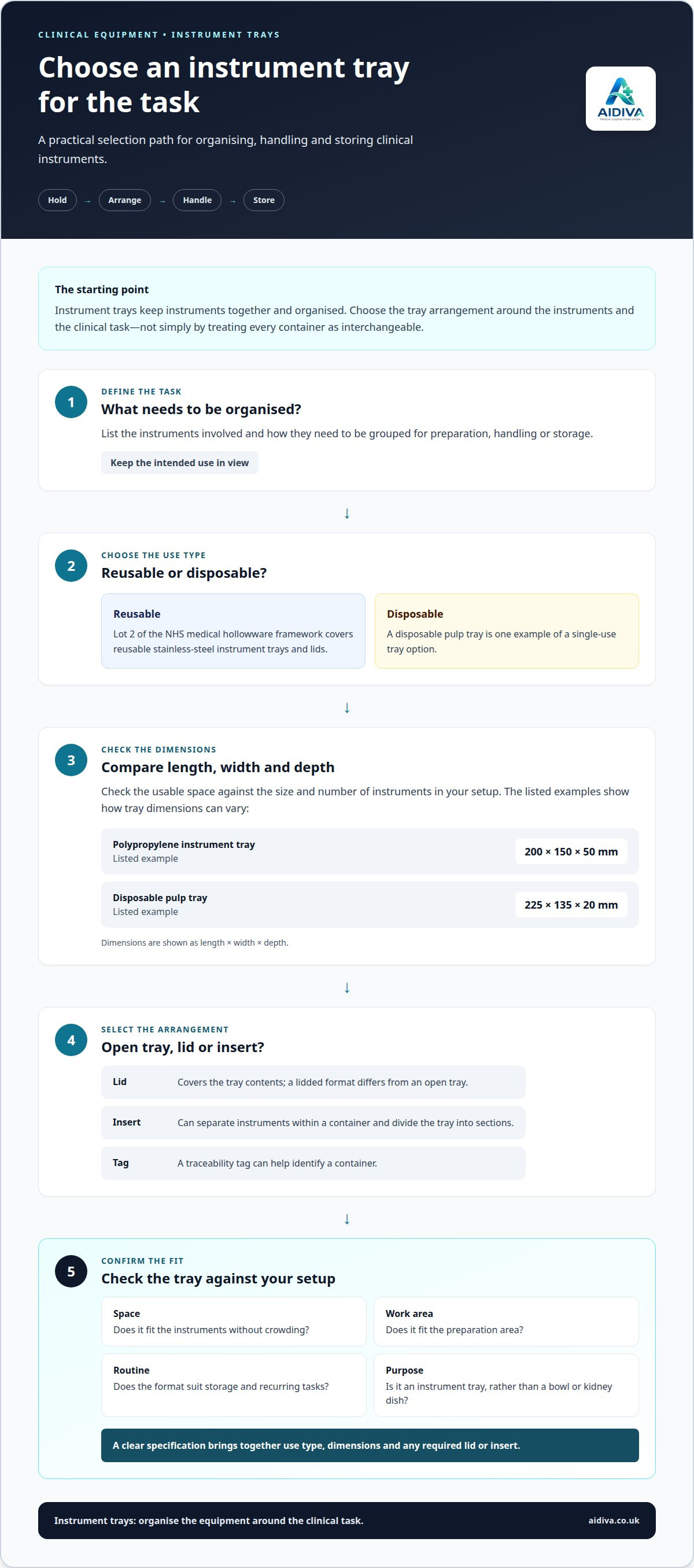
Instrument trays hold and organise instruments during clinical work. A tray can keep items together for preparation, handling or storage. Lids cover tray contents, while inserts can separate instruments within a container. Choose an arrangement to suit the instruments and task. A tray used for a group of instruments needs enough space to keep them organised without crowding.
Lot 2 of the NHS medical hollowware framework covers reusable stainless-steel instrument trays and lids. It also covers traceability tags, silicone inserts, instrument containers and jugs. These accessories support different handling and organisation needs. For example, an insert can divide a tray into sections, while a traceability tag helps identify a container. A tray with a lid offers a different format from an open tray.
Dimensions help you assess whether a tray suits the items it must hold. One listed polypropylene instrument tray measures 200 mm × 150 mm × 50 mm. A disposable pulp tray measures 225 mm × 135 mm × 20 mm. These examples show that tray dimensions and materials vary. Compare the usable space with the size and number of instruments in your setup.
Start with the task and the instruments involved. Decide whether you need a reusable tray or a disposable option. Then consider the required length, width and depth, and whether a lid or insert would support the intended arrangement. A shallow tray may suit items that need a clear layout, while a deeper format provides more depth for its contents. Check that the tray fits your preparation area and storage routine. Keeping tray types consistent within a clinical setup can also make it easier to organise equipment for recurring tasks. These checks help distinguish instrument trays from bowls and kidney dishes, which serve other purposes.
Which UK suppliers manufacture or sell medical holloware?
UK buyers can identify five suppliers through the NHS medical hollowware framework: Continuum Scotland Ltd, GenX MediCare, MedScience Distribution Ltd, Praxis Medical Ltd and Vernacare International Ltd. This named group offers a starting point for procurement research. It shows which organisations appear on the framework, not which company makes every individual item.
The framework carries reference 2024/S 000-014263. It runs from 7 April 2025 to 6 April 2029, for 48 months. That gives the supplier list a defined purchasing context. Buyers can use the reference when discussing framework-related sourcing internally. The framework information identifies suppliers, but does not assign every product to a named manufacturer.
Separate the supplier question from the product question. If your department needs instrument trays, identify the required tray type, then compare relevant listings. A team sourcing single-use kidney dishes has a different product brief. Naming Continuum Scotland Ltd or Vernacare International Ltd alone does not describe a particular tray, bowl or container.
Build a short specification before assessing supplier options. Record whether the requirement is reusable or single-use, the item type, relevant dimensions, and whether lids or inserts are needed. For instance, an instrument tray with a lid differs from a kidney dish. This makes product-level comparisons clearer across the five framework suppliers and separates supplier identity from item suitability.
Use the framework list as a route to suppliers, then match each listed item to its clinical task. Start with the intended use and item specification, not the supplier name alone.
The change to the new NHS medical hollowware framework results in a 100% delist of incumbent suppliers, so buyers should check current arrangements rather than assume an existing supplier remains listed. The NHS Supply Chain reusable plastic medical hollowware framework starts on 15 September 2025 and expires on 14 September 2027. It runs for 24 months, with an option to extend for an additional 24 months. Its reference is 2025/S 000-003545.
This reusable plastic framework has a defined scope and term, so consider it separately from the wider supplier list above. Buyers can use its reference to assess whether a reusable plastic requirement fits the arrangement, while still confirming that a listed product meets the clinical specification. The delisting change and framework dates provide context for planning sourcing and reviewing continuity of supply.
What materials are used for medical holloware, and how do they compare?
Medical holloware in the UK includes disposable pulp, reusable plastic and stainless-steel options. These materials suit different workflows: pulp items are single-use, while plastic and stainless-steel holloware can be reusable. Compare the material alongside the item’s form. A bowl, medicine measure and instrument tray have different purposes, so material alone cannot determine suitability.
Disposable pulp items include bowls, kidney dishes, gallipots and medicine pots. They suit tasks where an item is used once rather than returned to stock. Reusable plastic offers another option for clinical hollowware. The NHS Supply Chain reusable plastic medical hollowware framework adds 30 new products, broadening the range of products in this category. Consider the task and item type when comparing these choices.
Capacity provides one practical comparison point. The HPC detergent-proof wash bowl has a capacity of 4 litres. This example shows why the item’s dimensions or capacity matter alongside its material. A wash bowl and a medicine measure perform different functions, even if both are reusable. Match the item’s stated capacity with the intended task and clinical routine.
The stainless-steel hollowware range is made from 304 stainless steel. This identifier helps distinguish the material in product information. For UK clinical teams, compare whether a single-use pulp item or reusable plastic or stainless-steel option suits the workflow. Then assess the product’s form, dimensions and capacity. These details help you compare choices without treating all hollowware as interchangeable. The intended task remains central: a receptacle, tray and wash bowl each serve a distinct role.
AIDIVA’s collection includes disposable pulp and reusable plastic items, giving teams options to consider based on how holloware is used and handled. Choose according to whether the item is intended for one use or fits an established reusable workflow, as well as the task it must support. Considering these points together makes comparisons more practical than choosing by material label alone.
When reviewing a particular product, check that its stated form and capacity suit the intended use, then consider how it fits into the local routine for obtaining, using and managing holloware. This keeps the comparison focused on the item’s role and the workflow around it, rather than treating one material as suitable for every situation.
AIDIVA: Holloware
AIDIVA offers holloware for individuals, carers, healthcare professionals and organisations sourcing clinical essentials. Once you have identified the item you need, explore AIDIVA’s online product range. Your choice depends on the task, the item required and whether it needs to be single-use or reusable. Keep those requirements clear as you select suitable items for your setting.
Start by defining the item’s purpose. A receptacle, medicine measure and instrument tray serve different functions, so the category alone cannot determine what suits your workflow. Consider the required format, material and dimensions, where relevant. These details help you organise your selection, whether you are equipping a care setting or replenishing clinical supplies.
AIDIVA also offers Monitoring Equipment, Defibrillators and Defibrillators' accessories. These categories may be useful when your organisation is sourcing more than one type of healthcare essential. The team’s knowledge of clinical supply categories can help you navigate the range of product areas. Each has a distinct purpose, so keep your requirements focused on the task each item must support.
Before choosing holloware, identify its intended use and the product type you need. Then consider which details matter in your setting, such as material, shape or capacity. A team selecting a tray has different needs from one choosing a bowl. A clear specification keeps your selection focused and avoids treating different items as interchangeable.
To discuss your holloware requirements, contact AIDIVA.
Frequently Asked Questions
What does medical holloware mean in the UK?
In UK healthcare, medical holloware describes hollow containers and receptacles used for clinical tasks. The term covers different item types, not one particular product. For example, a care team may group medicine pots with measuring items while keeping collection dishes in a separate stock area. Organising items by their role helps staff select the right type for a routine task.
What types of medical holloware are used in UK healthcare?
UK healthcare settings use items such as instrument containers, denture containers, sputum containers, medicine measures and wash bowls. The required type depends on the task: a container with a lid can keep its contents covered, while a wash bowl serves a different care routine. Organising stock by item type and intended use can help teams distinguish products during preparation and replenishment.
What UK standards and regulations apply to medical holloware?
The NHS Supply Chain reusable plastic hollowware procurement was completed in line with the Procurement Act 2023. Its framework identifies carbon reduction, modern slavery assessment and social value requirements as PPN 06/21, PPN 02/23 and PPN 06/20.