

Blood pressure monitors for accurate home readings
Digital blood pressure monitors can provide useful home readings when you use them correctly and choose a cuff that fits your upper arm. An automatic upper-arm model is a practical choice for routine checks, while wrist and finger monitors are generally less reliable. This guide explains what to look for, how to take a reading and which features to compare.
Key Takeaways
- Choose an automatic upper-arm model with a cuff that fits you to support reliable readings.
- Compare home options by cuff size, ease of use and memory features that suit your routine.
- Prepare for a reading by resting quietly, sitting with your feet flat and placing the cuff on bare skin.
- Record your results and discuss your monitoring routine with a healthcare professional.
Are digital blood pressure monitors accurate?
A validated digital device with a correctly fitting cuff can provide useful home readings. Upper-arm monitors are generally preferred for routine checks.
Arm and wrist monitor accuracy
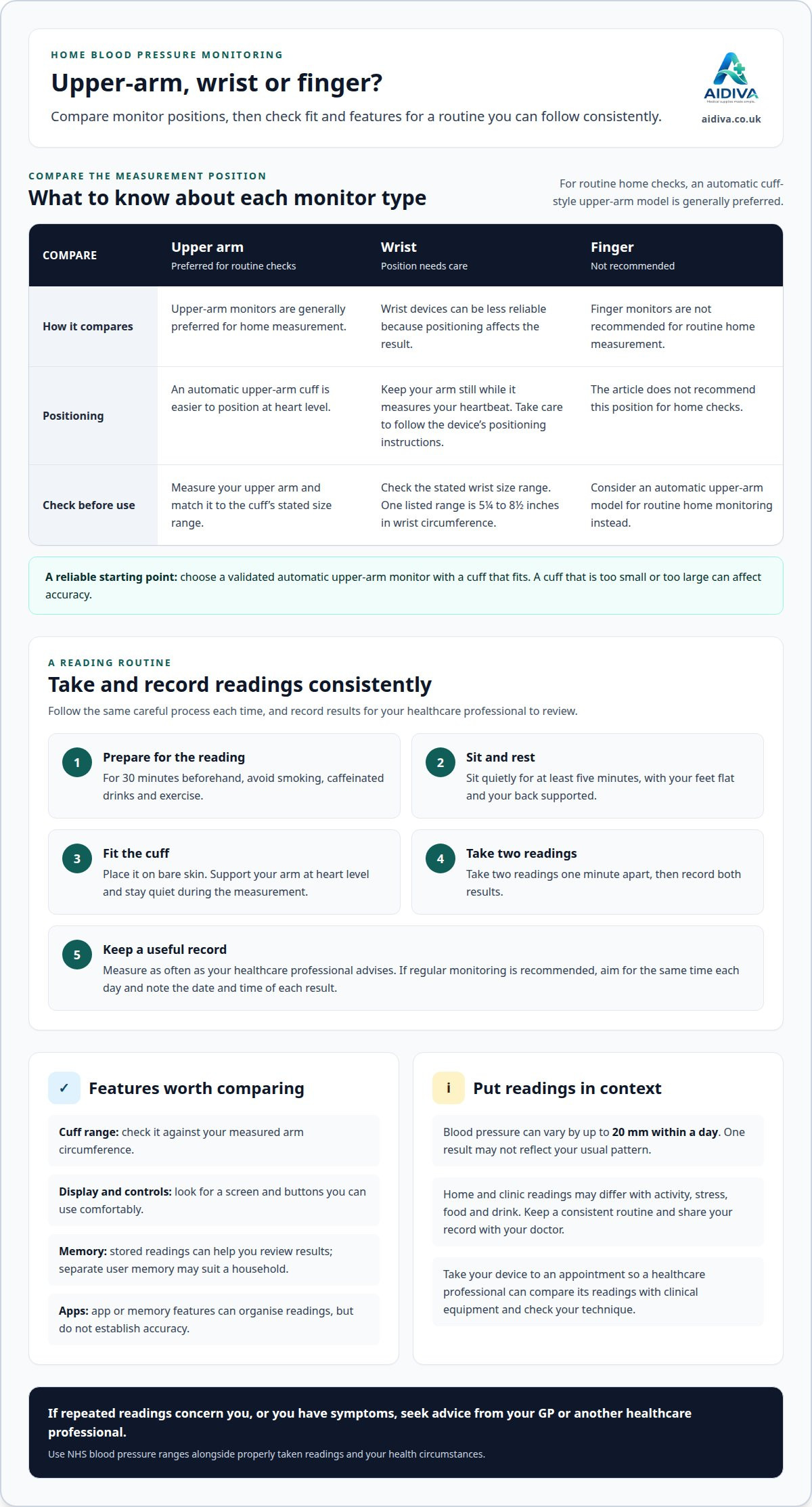
Automatic upper-arm cuffs are easier to position at heart level and are commonly recommended for home measurement. Wrist devices can be less reliable because positioning affects the result; finger monitors are not recommended. If considering a wrist model, check its stated size range. One listed range is 5¼ to 8½ inches in wrist circumference. Keep your arm still while it measures your heartbeat.
Validated monitors and cuff fit
Choose a validated device and take it to an appointment so a healthcare professional can compare its readings with clinical equipment. A cuff that is too small or too large can affect accuracy. Place it on bare skin and follow the manufacturer’s positioning instructions.
Consider NHS blood pressure ranges alongside properly taken readings and your health circumstances. Seek advice from your GP or another healthcare professional if repeated readings concern you or you have symptoms.
Cuff sizes and app features
Measure your upper arm and compare its circumference with the cuff’s stated range. Some models offer apps or memory to organise readings, but these features do not establish accuracy. Check that the display and stored results are easy to review with a doctor.
Access to a free or prescribed home monitor through the NHS can depend on your circumstances. Ask your GP or pharmacist about options relevant to your care.
For an accuracy check, take the device to an appointment and compare its readings with clinical equipment. Keep a record of results and discuss any concerns with your healthcare professional.
Monitor specifications: ±3 mgHg or 2% for blood pressure, ±5% for pulse. October 2025 AARP Smart Picks survey: 56 percent of home health monitor users aged 50 and older identified accuracy as important.
Best home blood pressure monitor recommendations
For home use, choose a validated automatic upper-arm model with a cuff that fits. A consistent measuring routine helps make your results useful to discuss with a healthcare professional.
Choosing a home monitor
Compare a monitor’s validation, cuff range, controls and display. Choose features that suit the person taking measurements, such as a clear screen or separate user memory. Home monitoring can help people diagnosed with high blood pressure track results between appointments. Bring the device to a check-up so your doctor can assess your technique and compare its readings with clinical equipment.
Home and clinic readings
Home and clinic readings may differ because blood pressure changes with activity, stress, food and drink. A measurement reflects that moment, rather than every condition throughout your day. Keep your routine consistent and record results for your doctor to review alongside clinic readings. Your blood pressure can vary by up to 20 mm within a day, so a single result may not reflect your usual pattern.
Taking a home reading
Before measuring, avoid smoking, caffeinated drinks and exercise for 30 minutes. Sit quietly for at least five minutes, with your feet flat and back supported. Put the cuff on bare skin, support your arm at heart level and stay quiet during the measurement. Take two readings one minute apart, then record both results. Following these steps reduces common sources of inaccurate readings.
Measuring and recording results
Measure as often as your healthcare professional advises, and aim for the same time each day when regular monitoring is recommended. Record each reading with its date and time. Device memory can also help, particularly when several people use the monitor. Share the results with your doctor, who can consider the pattern alongside your health and treatment.
Choosing an automatic upper-arm monitor
For routine home use, an automatic cuff-style upper-arm model is a practical choice. Compare the options by how well they fit your measurements and routine.
Comparing monitor positions
Upper-arm, wrist and finger devices measure at different points, and positioning affects how reliably you can use them. Wrist and finger monitors are generally less reliable than upper-arm models. Wrist monitors require particular care with placement. Choose a position you can use consistently, especially if you’ll measure blood pressure at home regularly.
Consider how you’ll sit and support your arm during a reading. An upper-arm device suits a routine where you can rest your arm comfortably, while maintaining the right position with a wrist monitor may be harder. Finger monitors are not the preferred option for routine home use. Choose a method you can follow correctly each time.
Upper-arm monitor options
Automatic models inflate the cuff and display the result without requiring you to operate a manual pump. Compare the display, buttons and stored-reading functions. If others will use the device, check whether its user-memory setup suits your household. Practical features like these can make the routine easier to manage.
Before choosing, measure your upper arm and compare its circumference with the model’s stated cuff range. A readable screen and straightforward controls can make independent use easier. If you plan to review results with a healthcare professional, consider how clearly the device presents stored readings. Prioritise a model you can use comfortably and consistently over one with extra features you may not need.
The American Heart Association recommends automatic cuff-style upper-arm monitors for home blood pressure monitoring. It also recommends using an automatic, cuff-style upper-arm blood pressure monitor.
This recommendation makes the measurement method a sensible starting point when comparing models. Then check whether the cuff range matches your measured upper arm and whether the screen and controls suit your routine. A device you can operate comfortably and consistently is more useful than one with additional functions that are difficult to use.
Blood pressure monitor product listings
Compare listings by cuff range, memory, screen and stated functions rather than relying on model names alone. These details help you judge whether a device suits your arm and how you plan to review readings. Match each feature to the exact model and its intended use, as product descriptions can vary.
For example, one no-wrap listing gives an auto-fit arm range of 8.7-15.7 inches and stores 199 readings for each of three users. Another lists a larger cuff range of 8.7-16.5 inches and memory for two users, with 120 readings each. These are different configurations, not universal specifications. Measure your upper arm and compare its circumference with the stated cuff range before choosing.
Memory can be useful if you take readings regularly or share a device. A listing for two users with 99 readings each offers a different record-keeping arrangement from a three-user model. Check whether the memory separates each user’s blood pressure readings, and whether the screen makes stored results easy to review. A large LCD or talking function may also help you access results, depending on your needs.
Some descriptions mention Bluetooth, a model series or an irregular heartbeat indicator. These are distinct functions: Bluetooth transfers data, while an irregular heartbeat alert is not the same as a blood pressure result. Check the listing for the exact feature and how it works. Monitoring still depends on correct use and interpreting readings with appropriate professional advice.
Compare cuff range first, followed by user memory, display and any additional functions. A comfortable fit and readable results matter more than a long feature list. Check specifications for the exact model, as features can differ across a series. This makes it easier to compare listings without assuming every model includes the same functions.
AIDIVA: Monitoring Equipment
AIDIVA offers monitoring equipment for people, carers and organisations choosing equipment for routine health checks. If you’re selecting a home blood pressure monitor, compare the cuff range, display clarity and features against your measuring and recording routine. AIDIVA also supplies personal care and medication aids, as well as defibrillators and accessories for other healthcare needs.
Monitoring equipment supports routine measurement, but it does not replace medical advice or treatment. For help choosing equipment for your requirements, contact AIDIVA.
Make your next step practical
Consider who will use the equipment and how its readings will support ongoing care. A blood pressure monitor can form part of an everyday routine, with readings helping you discuss changes with a healthcare professional. Choose a monitor that suits the person using it and the place where measurements will be taken.
AIDIVA offers monitoring equipment, first aid kits and defibrillator accessories for a range of care and safety needs. Consider what your home, caring role or organisation requires, and how the equipment will fit into your usual routines.
For practical help with your requirements, contact AIDIVA with your questions. Take the next step at a pace that suits you.
Frequently Asked Questions
How do I properly take my blood pressure at home?
Use a quiet setting and keep still throughout the measurement. Avoid talking or listening actively, as this can affect the result. A distended bladder can also cause a discrepancy of 15/10 mm Hg, so use the toilet beforehand. Take readings at a consistent time and note anything that may have affected them, such as recent activity, stress or a caffeinated drink.
How do I know if I have put on the arm cuff correctly?
Follow the placement diagram supplied with your device, and put the cuff on bare skin, not over a sleeve. Align its marker or tube as the manufacturer’s instructions show, then keep your arm supported and still while the cuff inflates. If the cuff twists, slips or feels uncomfortably tight, reposition it before measuring. A healthcare professional can review your technique at an appointment.
What features should I look for?
Start with the essentials: a cuff that fits, manageable controls and a readable display. Extra functions may suit some routines but are not necessary for everyone. Consider which features matter to you rather than choosing solely for a long specification list or app connection.
Is it normal for my blood pressure to vary?
Yes, readings can change during the day. Activity, food or drink and stress are among the factors that affect them, and a person’s pressure can vary by up to 20 mm within a day. One result may not represent your usual pattern. Keep a record over time and discuss repeated concerns or changes with your healthcare professional.
Is it user-friendly?
The right choice depends on which controls and display you find easiest to use. Before choosing, consider whether you can read the screen, position the cuff and understand the results without assistance. A simple memory function may help you review previous measurements. If you care for someone else, consider whether they can operate the device comfortably and follow its instructions.
What are some common reasons why my blood pressure readings seem higher than expected?
Common causes include measuring over clothing, using a cuff that’s too small, smoking shortly before a reading, or talking during measurement. Clothing can cause a systolic discrepancy of 5-50 mm Hg; a cuff that’s too small can affect systolic and diastolic results. Rest, repeat the measurement correctly, and record both results. Discuss repeated high readings with a healthcare professional.