

Medical monitoring equipment in the UK for inpatient safety
In inpatient care, medical monitoring equipment in the UK supports safety by measuring ECG, respiration, blood pressure, oxygen saturation (SpO2) and body temperature, with the right combination shaped by the patient’s needs and level of care.
These measurements help staff track a patient’s condition, but monitoring needs vary between routine ward care and specialist settings such as operating theatres or neurology. Bedside alarm systems can also alert staff when medical devices sound alarms.
This guide explains the difference between routine and specialist monitoring, what vital signs, theatre and neurology equipment can measure, and which UK requirements and technical standards may apply. It helps clarify the role each device plays in inpatient care.
Key Takeaways
- Match monitoring categories to the patient’s needs and the level of care provided.
- Learn which vital signs monitors can track and how those readings support inpatient observation.
- Understand why medical device requirements differ by device type and monitoring function.
- See how theatre and specialist neurology monitoring address needs beyond routine vital signs.
Non-specialist and specialist patient-monitoring categories
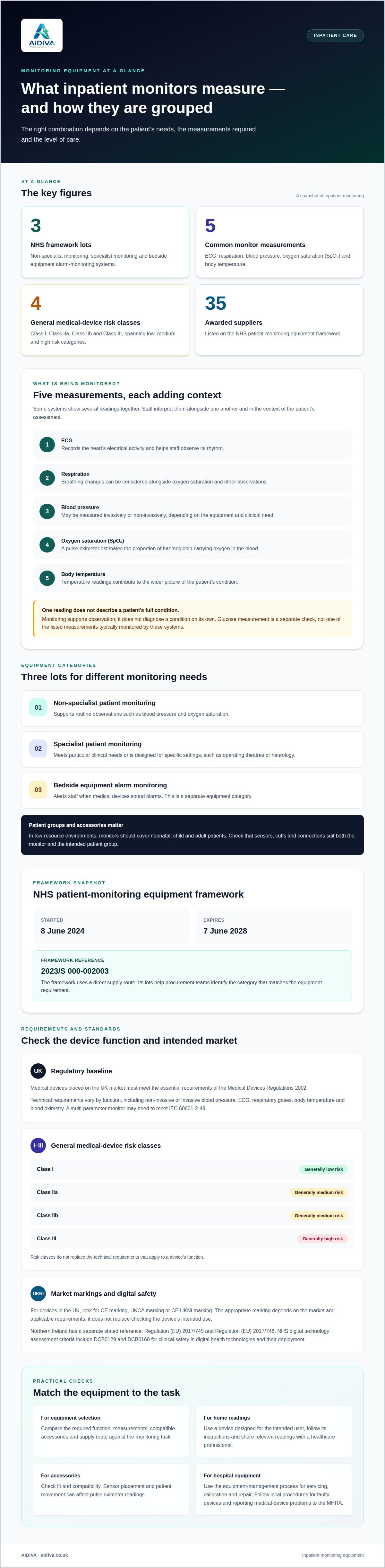
Hospitals group patient-monitoring equipment according to the care setting and measurements required. Non-specialist monitors support routine observations such as blood pressure and oxygen saturation. Specialist devices meet particular clinical needs or are designed for specific settings. Bedside equipment alarm-monitoring systems are a separate category: they alert staff to alarms from medical devices. The NHS patient-monitoring equipment framework separates provision into these three lots.
In low-resource environments, patient monitors should cover neonatal, child and adult patients, helping facilities meet the needs of different patient groups. Accessories must also suit both the patient and the monitor. Check that sensors, cuffs and other connections are compatible with the device and intended patient group rather than assuming one accessory fits all.
The NHS framework uses a direct supply route and lists 35 awarded suppliers. It began on 8 June 2024 and expires on 7 June 2028. Its reference is 2023/S 000-002003. For a hospital, the lots distinguish non-specialist monitoring, specialist monitoring and bedside alarm systems. This structure helps procurement teams identify the category that matches their equipment requirement.
For home blood pressure monitoring, choose a device designed for the intended user and follow the instructions for cuff placement. For a pulse oximeter or ECG monitor, match the device to the measurement needed and learn how to record readings correctly. Keep readings to discuss with a healthcare professional.
A consumer monitor’s accuracy depends on the device, its fit and how it is used. Do not assume a home reading will match one from clinical equipment. Follow the manufacturer’s instructions and share readings with your healthcare team when they are relevant to your care.
Select equipment by category, required functions, compatible accessories and supply route. Blood pressure monitors, pulse oximeters and ECG monitors serve different purposes, so compare specifications against the monitoring task before choosing.
At home, read the device instructions, prepare the correct accessories and follow the stated measurement steps. In hospitals, servicing, calibration and repair should go through the equipment-management process. Staff should know the local procedure for faulty devices and how to report a medical-device problem to the MHRA.
What medical monitoring devices support inpatient safety?
Inpatient monitors help staff observe changes in a patient’s condition through several measurements. The combination used depends on the clinical assessment and care setting.
Vital signs measured by monitors
A patient monitor can measure ECG, respiration, blood pressure, oxygen saturation (SpO2) and body temperature. Some systems display several readings together, helping staff review changes across more than one measurement. Blood pressure may be measured invasively or non-invasively, depending on the equipment and clinical need. Each reading contributes information, but no single measurement describes a patient’s full condition.
Oxygen saturation measurement
Oxygen saturation measurement estimates the proportion of haemoglobin carrying oxygen in the blood. A pulse oximeter uses a sensor, commonly placed on a finger, and displays an SpO2 reading. It provides a quick measure that staff can consider alongside respiration, heart rate and other observations. Sensor placement and patient movement can affect readings, so staff follow the device instructions and interpret results in context.
ECG monitoring records the heart’s electrical activity and helps staff observe its rhythm. In hospital, electrodes connect the patient to the monitor, and the displayed trace provides information for assessment. ECG is different from blood pressure measurement, even when both appear on the same screen. Readings inform clinical decisions but do not replace an examination or other assessment.
Respiration and temperature add further context. A change in breathing can be considered with SpO2, while temperature readings help staff assess the patient’s condition alongside other findings. Some medical devices measure specific parameters only, while multi-parameter monitors combine several. Glucose measurement is a separate check, not one of the listed measurements typically monitored by these systems.
For inpatient safety, choose equipment that measures the required parameters and presents them clearly for the care setting. Staff interpret readings together, note changes and take appropriate action under local clinical guidance. Monitoring supports observation; it does not diagnose a condition on its own.
Regulatory and technical standards
Medical devices placed on the UK market must meet the essential requirements of the Medical Devices Regulations 2002, according to The National Archives. This is the regulatory baseline for equipment such as patient monitors. The specific technical requirements also depend on what a device measures. Non-invasive blood pressure, invasive blood pressure, ECG, respiratory gases, body temperature and blood oximetry have different compliance requirements.
General medical devices fall into risk classes. Class I is generally regarded as low risk; Class IIa and Class IIb are generally regarded as medium risk. Class III is generally regarded as high risk. These categories distinguish risk levels, but do not replace the technical requirements that apply to a device’s function. A monitor measuring several parameters may need to meet IEC 60601-2-49.
Northern Ireland has a separate stated regulatory reference: medical devices must meet the general safety and performance requirements in Regulation (EU) 2017/745 and Regulation (EU) 2017/746. For devices in the UK, patients are advised to look for CE marking, UKCA marking or CE UKNI marking before buying. The appropriate marking depends on the market and applicable requirements; it is not a substitute for understanding the device’s intended use.
Digital patient-monitoring systems also raise clinical safety considerations. NHS digital technology assessment criteria include DCB0129 and DCB0160. These standards concern clinical safety in digital health technologies and their deployment. They are distinct from technical requirements for a physical monitor measuring blood pressure or ECG. When assessing a system, identify whether it is a standalone medical device or part of a digital technology workflow.
For procurement, match the device’s stated purpose to the clinical condition and monitoring task. Review its applicable regulatory marking and technical requirements, including those for the relevant measurement parameter. A multi-parameter monitor and a single-parameter device may follow different compliance routes. Assessing intended use, measurement function and applicable standards together helps ensure the review fits the equipment.
Vital signs, theatre and specialist neurology monitoring
Monitoring needs vary between a general ward, an operating theatre and specialist neurology care. The patient’s condition and the clinical task determine which readings staff need to follow.
A multi-parameter monitor can track ECG, blood pressure, heart rate, temperature and oxygen saturation simultaneously. In theatre, blood pressure deserves particular attention during spinal anaesthesia, which can significantly lower it. Staff also use capnography with circle machines and may use it for other types of general anaesthetic. Together, these measurements help the clinical team observe the patient during anaesthesia.
Capnography measures carbon dioxide in exhaled breath and adds information about ventilation during anaesthesia. Anaesthetic-agent levels should be monitored in a closed system. These functions have different purposes: capnography tracks exhaled carbon dioxide, while agent monitoring measures substances delivered through the anaesthetic system. Choose equipment according to the procedure and the measurements the team needs.
The right equipment for specialist neurology monitoring depends on the clinical question and the patient’s condition. The monitoring plan should specify which changes staff need to observe and how readings will support assessment. Use equipment suited to that purpose: a general vital-signs display may not provide the specialist information needed for neurological care.
Alarm settings require careful attention. Too many alerts can cause staff to stop noticing them, so hospitals should set thresholds thoughtfully for each patient and clinical context. Staff should also check alarms, maintain and calibrate devices, and receive training in their use. These steps help keep readings reliable and alerts useful during care.
Follow the device instructions and local clinical procedures when setting up monitoring. Confirm that sensors and connections are correctly applied, then check that the expected readings and alarms appear. For theatre or specialist use, equipment checks should reflect the measurements required for the procedure or assessment.
Explore monitoring equipment for patient-care settings.
Medical Aid International identifies blood pressure as a vital parameter for patients undergoing spinal anaesthesia, which can significantly lower it; capnography is essential with circle machines and highly desirable for all types of general anaesthetic.
AIDIVA: Monitoring Equipment
AIDIVA offers monitoring equipment for individuals, carers, healthcare professionals and organisations sourcing equipment for patient care. Once you’ve identified the measurements and setting required, you can browse this category for suitable equipment. AIDIVA also offers defibrillators, defibrillator accessories and personal care and medication aids, which may support other healthcare and preparedness needs. The right choice depends on the intended use, required readings and compatible accessories. For clinical decisions, use readings as part of appropriate professional assessment; equipment does not replace medical advice or treatment. If you need to discuss sourcing monitoring equipment, contact AIDIVA.
Plan your next equipment decision
Turn your monitoring requirements into a clear purchasing brief. Record the care setting, measurements needed and any accessory compatibility requirements. This gives your team a practical basis for selecting medical monitoring equipment in the UK and matching it to its intended use.
AIDIVA offers monitoring equipment, first aid kits and defibrillator accessories for healthcare and preparedness needs. Explore these product categories when planning what to source. Choose equipment suited to your setting and intended use, and keep its product information available to the staff who will handle it.
For help with your next equipment enquiry, contact AIDIVA about monitoring equipment. A clear brief is a useful starting point for your next purchasing decision.
Frequently asked questions
What types of medical monitoring equipment are available in the UK?
Available equipment ranges from portable units for individual checks to monitors used in clinical workflows. To narrow the options, consider who will apply the device, whether the patient can use it independently, and how readings will be recorded and shared. Also account for practical needs such as power, compatible consumables, cleaning and the manufacturer’s instructions for the intended user.
What is the difference between NHS-provided and privately purchased monitoring equipment?
NHS-provided equipment is arranged through a patient’s care pathway, while privately purchased equipment is selected and bought by an individual or organisation. This affects who coordinates the choice and how the device fits into ongoing care. If you buy privately, keep the instructions and reading records accessible, and tell the relevant healthcare team if readings will inform care.
What UK regulations and certifications apply to medical monitoring devices?
Requirements depend on the device’s intended purpose and the market in which it is supplied. When purchasing, assess the manufacturer’s conformity documentation alongside the product information, rather than relying on a marketing description alone. Keep these documents with the instructions and procurement record. They give staff a practical reference for identifying the model and its stated use during routine equipment management.
Can medical monitoring equipment be prescribed or funded by the NHS in the UK?
NHS provision depends on a patient’s clinical need and care pathway. If you need monitoring as part of ongoing care, explain your concern to the team responsible and describe how readings could support that care. The team can consider suitable equipment and arrangements within the patient’s care plan. Private purchase is a separate route and does not determine NHS provision.